Ashore · outdoors
Access to the hull.
Easier access below the waterline for inspection and maintenance. The boat remains exposed to the weather; supports, keel and lifting arrangements must be suitable.
Port Napoléon · a possible preparation base
Port Napoléon is a possible base for work and testing before departure. Preparation and sea trials can take place here before moving the boat to a joining harbour along the coast.
The facility is at Port-Saint-Louis-du-Rhône, west of Marseille, and is also a possible base between trips. The storage arrangement, timing and length of stay need to be agreed.
It is about 200 nautical miles to Ajaccio in Corsica, and about 240 nautical miles to Alghero in Sardinia. These are estimates for direct delivery passages without holiday detours. Wind and route choices affect the distance sailed.
Port Napoléon, the neighbouring Navy Service yard and the municipal harbour basin at Port-Saint-Louis are three different facilities. Agree on Port Napoléon’s own entrance and reception arrangements before travelling, using the address Rue Canal Saint Antoine l’Ermite, Presqu’île du Mazet.
Access from the sea is via the Golfe de Fos and Canal Saint Antoine. Arrival from the Rhône through a lock is another option; the lock is not required when coming by sea.
Operator’s access information ↗Between trips
The choice affects both the work before departure and care between trips. The particular boat and storage arrangement need approval.
Ashore · outdoors
Easier access below the waterline for inspection and maintenance. The boat remains exposed to the weather; supports, keel and lifting arrangements must be suitable.
Ashore · under cover
The shed protects against the weather but requires a separate plan for the mast, height and moving the boat. The work permitted while the boat is inside needs to be agreed.
Actual loaded weight, beam including projections, current draught, lifting points and keel supports must be accepted. The shed entrance is listed as 9.60 metres wide and 9.40 metres high. Unstepping and storing the mast, height on supports or a transport cradle, manoeuvring room and available capacity also need consideration. A lifting keel does not resolve all these questions.
Before departure
First work ashore, then testing afloat, and finally the passage to the joining harbour. Services and time alongside must be arranged; the dates need to allow for delays and weather.
Confirm the scope of work, people, parts, lifts and space before travelling.
Inspect the hull and keel, and carry out work that requires the boat to be out of the water.
Test the engine, through-hulls, rig and equipment while help is still available.
Resolve what the tests reveal. Then move the boat to the agreed joining harbour when the weather allows.
A prepared boat leaves room to unpack and find dinner on the first evening.
General surveillance of the site is different from looking after an individual boat. Individual care requires a named person responsible, agreed checks, reports and a plan for who acts if problems arise.
Owner-performed work follows the site’s rules. External tradespeople must agree access and organisation with the harbour; permission, the appropriate work area and any access charges need confirmation. The presence of a service on site does not demonstrate experience with the equipment in the particular boat.
The terms prohibit unattended electrical connections. Separate restrictions apply to work inside the shed, including charging, hot work and generators. Continuous shore power and battery charging therefore cannot be assumed while the boat is left unattended.
View terms · 1 July 2025 · PDF ↗The working days
The on-site Les Trois Voiles hotel provides a possible base for sleeping, eating and washing clothes while the boat is a workplace. Opening and room availability for the intended dates need confirmation.
The hotel’s own page advertises renovated rooms, breakfast, a restaurant and laundry facilities. This updates older FAQ wording about ongoing renovation. Limited stays aboard ashore during preparation or winterisation are different from permission to live there permanently.
The FAQ describes grocery collection lockers and a chandlery. Parcels and pre-ordered fuel require separate delivery arrangements; fuel delivery does not mean there is an accessible fuel berth. Parts should have a confirmed recipient and delivery date.
Les Trois Voiles · rooms and services ↗FAQ · stays and daily services ↗A taxi or hire car to the agreed entrance is the suggested option with tools and luggage. The A1 bus runs to Saint-Charles in Marseille, not to the boatyard.
The 2025 TAD information lists Port Napoléon and Navy Service as separate stops for local on-demand transport. The journey must be booked. The complete public transport chain from the airport to the boatyard has not been verified; routes, connections and booking need to be checked for the working dates.
View local TAD route · 2025 · PDF ↗A1: airport–Saint-Charles ↗A separate start to the holiday
Marseille, Toulon and Hyères lie along the mainland coast. Each needs a confirmed berth and a straightforward last leg from the airport or station. The choice of joining harbour and the onward holiday route are separate questions.
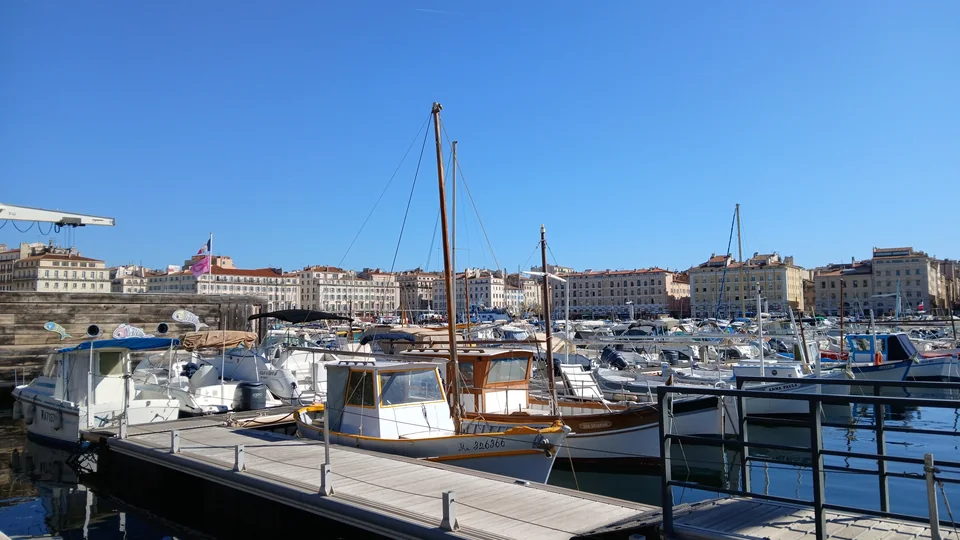
Marseille · Vieux-Port
Vieux-Port has city life close by, with dinner and coffee beside the harbour. La Nautique welcomes visiting yachts; a specific berth must be accepted for the particular boat.
The A1 from Marseille airport terminates at Saint-Charles; transport to the agreed pontoon remains from there.
Airport A1 connection ↗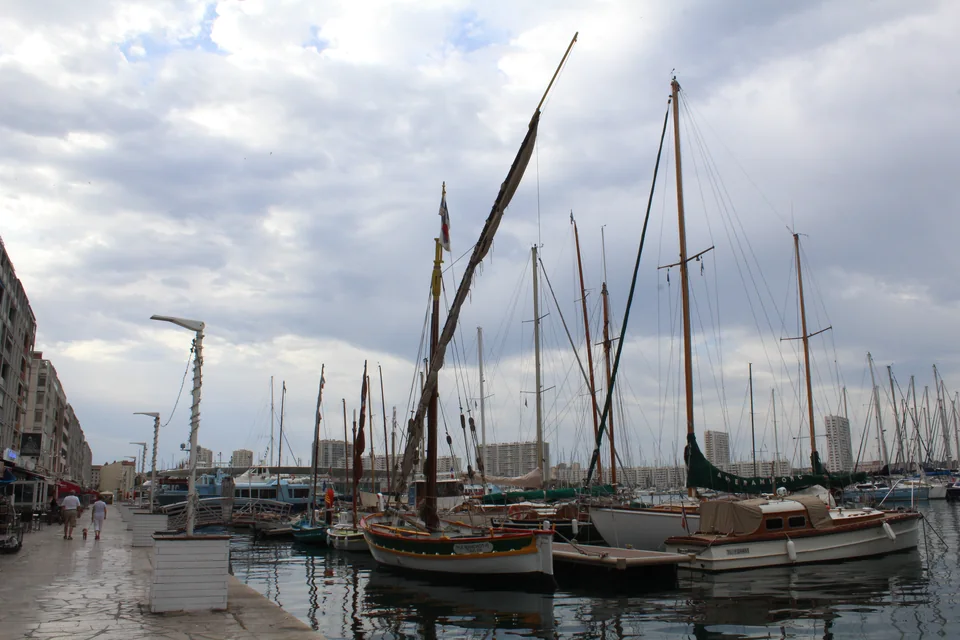
Toulon · Vieille Darse
The harbour promenade offers a stroll before dinner, with the old town close by. Vieille Darse is an option if Maribay confirms a berth for the particular boat.
Toulon can be reached by train or bus, or by bus 102 from Toulon–Hyères airport to the station. Transport to the pontoon remains from there. The operator’s estimate of a 15-minute walk from the station is not a promise of journey time with luggage.
Airport bus connections ↗Hyères · Saint-Pierre
Saint-Pierre is by the sea, with the possibility of a walk along the pontoons after dinner aboard. Hyères old town is a separate place to visit.
Bus 63 lists both the airport and Port St Pierre. Check departures for the travel day and the final walk to the agreed entrance. Proximity to the islands alone says nothing about permitted landings or where a later sailing holiday can go.
Réseau Mistral · bus 63 ↗A separate option
Ajaccio could be an option after a delivery passage with its own weather margin. Flights should not depend on a tightly scheduled crossing. The crossing could also form part of the trip; some longer legs over 50 nautical miles are not ruled out.
Airport bus 11 runs to Place De Gaulle, according to the current CAPAMOVE information. A final transfer is then needed to the right entrance at Charles Ornano. Older information about route 8 to Gare CFC has not been used.
The mistral can affect the coast and the crossing. The weather margin must reflect conditions when the time comes, not the map’s straight-line distance or a fixed departure threshold.
CAPAMOVE · airport bus 11 ↗Météo-France · regional winds ↗The whole stay
A quotation needs to cover the particular boat and the complete process, with prices excluding VAT, a date and a clear scope.
The 2026 price list describes Aventure as eleven months afloat and one ashore. The website says one year afloat and 30 days ashore. The duration and what is actually included need to be confirmed in a specific quotation. Electricity is extra; the application and calculation basis of other extras also need checking. Monthly billing does not necessarily mean a monthly commitment.
The documents below are the operator’s originals. They show published terms and prices, not a specific quotation for a boat. The 2022 brochure is used for orientation around the site, not as an up-to-date guarantee of services.
Operator’s package description ↗See the place in use
Older footage gives an impression of the site and the work. Current arrangements and the particular boat’s needs must be confirmed separately.
Port Napoléon is presented as a possible technical base. Berthing, storage, services, prices and travel must be arranged for each stay. Sources on capacity, work, costs and arrival appear beside the relevant sections; conflicting information has been retained.
The photographs show the joining harbours of Marseille and Toulon on the dates given in the captions. They do not show Port Napoléon or reserved berths. The photographer, source and licence appear beside each photograph.
The maps were drawn for Sophie using Natural Earth 1:10m Land, version 5.1.1, and approximate harbour positions from operator and authority sources.
The delivery distances to Ajaccio and Alghero are our own rounded calculations along the sea route, departing from the Golfe de Fos and passing outside the Îles Sanguinaires and Capo Caccia respectively. The endpoints are based on harbour information from Charles Ornano in Ajaccio and Porto di Alghero. Calculated on 19 September 2026.
Selected frames have been reviewed visually, without sound. The films have not been watched in full and are not used as working instructions or evidence of current services.